
Drowning in slop
The automated spectacle

‘Does Big Brother exist?’
‘Of course he exists. The Party exists. Big Brother is the embodiment of the Party.’
‘Does he exist in the same way as I exist?’
‘You do not exist.’
I’m reading the relaunched blog by one of the bigger names from the early paleo movement around fifteen years ago. It’s got a sketchy address, and a bit too few subscribers for a guy that used to be among of the major ones, but everything checks out well enough. And it’s indeed linked by the official blue-checked account on Twitter.
But I can’t be sure, can I? The content could certainly be AI-generated, trained on his almost two decades of now inaccessible previous posts, with his brand being bought by whatever corporation wants to leverage his curated credibility for selling us their shit.

The thing is that I really can’t know.
And there’s something profoundly disturbing in this weird epistemic liminality, spreading out across the digital dystopia. Something deeply strange in being permanently perched, like this ragged crow, on the threshold of verifying or falsifying, of a certitude beyond reach, never being able to move forward.
There’s almost a Kierkegaardian unease here, an infectious inability of the understanding to arrive at certainty, that threatens to spread, to infect the whole of the human life-world.
Yet no leap of faith is possible, because the choice is increasingly only between simulations. We’re moving towards a point where there’s no transcendence, no clear path towards breaking out of the spectacle and back into reality. The ladder has been pushed down since we climbed it.
Because the choice is only between the officially curated avatar, with its clickbait, digital mass-marketing and ghostwritten articles, and the AI-generated simulation.
And it’s not obvious that there’s a deep ontological difference here.
Does Mark Sisson really exist, or is he just a digital simulacrum? This very kind of question is increasingly irrelevant, and I fear that future generations will be less and less able to understand it.
“What do you mean? The thing [spectacle] exists.”
Slop. Slop everywhere, and not a drop to drink. Not even a spoonful of Solzhenitsyn gulag fish soup broth —
Hamfisted propaganda or not, there’s something in the author’s One Day in the Life of Ivan Denisovich that remarkably well expresses the incredible beauty and goodness in even the minutest pleasures of conscious existence. There’s a reflection of the infinite in even the humblest and most debased mode of being. “There’s a crack in everything / that’s how the light gets in”.
Be happy. Christmas tree is in. I still smell the spruce from my childhood. Grandma’s Christmas lunches. First communion.
The green turpentine cold and the blood of the Lamb.
Someone close to me recently expressed how she couldn’t wait for generative AI to convincingly emulate her style of thought and writing, so she could outsource her work to the machine, while still in some sense being present in the output. Her agency still remaning, albeit transposed.
Perish the thought. I tell myself she’s able to approach this idea with anything other than abject digust only because she’s also steeped in the culture’s simplistic understanding of the human person. That the thought of transplanting oneself to a chatbot could seem both plausible and attracive only if we have a very diminished and distorted understanding of what human subjectivity actually is.
European government officials apparently don’t care about nuances such as the chatbot being able to convincingly emulate them, however. They have the gall to post AI-generated war propaganda on their Twitter accounts, meaning they’re literally outsourcing both policymaking and public communications to foreign corporations.
This is certainly history’s stupidest generation, led by dead-eyed bugmen entirely devoid of principles, convictions and substance of thought. People of the brand, human beings formed by the simulated relations of production.
The AI slop is the quintessential symbol of our time. It’s really the summarizing expression, the final statement of our entire civilization, the essence of its fundamental ethic in Oswald Spengler’s sense. The “final world-sentiment”.
So where Indian civilization crystallized with the spread of Buddhism, and Greco-Roman civilization settled into Stoicism as a comprehensive sentiment, the final, summarizing swan song of our culture is an oversized AI-generated rat penis stomping on the face of science, forever.
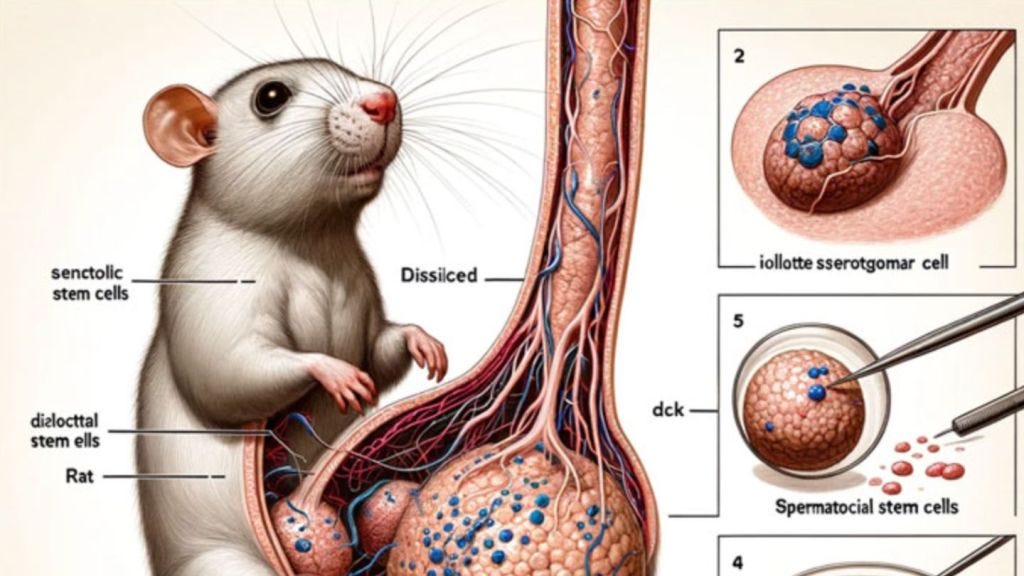
We deserve the culture we get. And this is also reflected in how rapidly and readily we’re adapting. Several new studies indicate that our constant exposure to slop is having a noticable impact on the characteristics of human discourse. We’re adapting our vocabularies and our styles of speech and writing to accommidate that of AI, which in due time is also going to render us increasingly unable to distinguish AI-generated content from the genuine human product.
Ours could be the last generation able to reliably tell the difference, not because AI “gets so much smarter”, and not because there are no enduring differences — but because the constant exposure to its output, as well as the atrophying of our own cognitive abilities, are rendering us increasingly useless in this very respect.
Compare to music. Someone classically trained and who has listened extensively to various historical composers will easily be able to pick out what sounds like a motet in the style of Mozart. They will also without issue distinguish such compositions from those of Bach.
Contrariwise, someone with a limited understanding of music, however adept in the content and form of Lil Nas X, will have no idea whatsoever.
And how long will people then be able to really understand the assertion that truth is different from authority?
When genuine knowledge becomes indistinguishable from the digital spectacle, meaningful dissent will seem like utter nonsense.
“Big Brother is not real?” What does that even mean?

All of the wisdom of this world is but a tiny raft upon which we must set sail when we leave this earth. If only there was a firmer foundation upon which to sail, perhaps some divine word.
(Socrates). Phaedo.
Great post. I probably restack-quoted half of it. All this tech was pitched as something like a "bicycle for the mind," but in reality it's becoming a wheelchair for the needlessly crippled who've chosen to let their legs wither from neglect until they can no longer even stand on their own. Offline and analog tech will make a comeback though.
Realistically, dissent and revolution are not possible. Beyond the usual rehashed kerfuffle discourses on the subject, the implications of that thing in 2020 was more telling than we want to admit. So within this sandbox some choices are possible, and the biggest upcoming choice will be whether to exit the brave new city or stay on with front row seats on the ride. In either case it's a one way ride and statistically the first three carriages in train wrecks receive the greatest damage. Just thought I'd point this out.
That image at the end looked familiar. So I did a quick search. I encountered similar images chasing down a rabbit hole, productions of "backrooms", in years past on YT. Searching for a clip to share here I noticed there's now an entire genre entitled "pool rooms". They're virtually identical to that insta account. Backrooms was based on an absurd premise of quasi reality inhabited by a weird monster-esque alien behind our reality accessible by doors and nondescript offices and malls hidden away by the deep state. It blended sci-fi with reality and in the early material played off real camera recordings with cgi. It was weird stuff, the sort without beginning or end, where you're not sure of what you're looking at, coming before the advent of LM/AI. But now any creator can run with it, and there's endless slop. And I can only imagine everyone's a genius.
It was interesting to read the linked article on the standardization of language used by academics tracing words more common with AI output. This plays on similar thoughts I've had on summarizing documents. The key to a great analysis is finding the key details, which might not be so obvious or based on previous takeaways. Beyond the "humans are lazy", I keep returning to the parallels with a recent conversation repeating the trope of our inability to go anywhere driving without using navigation tools. Our brains are formidable instruments, but like muscles need constant use to avoid atrophy.
So perhaps then, to your friend who wants to outsource writing to AI (incidentally I know a few who already do), we who still rely on the ancien méthode for doing stuff should rejoice. A decade from now, if we haven't on aggregate societally self deleted through predictive policing or AI led nuclear Armageddon, those of us who noticed how previous innovations turned out to change human behavior (navigator, social media, smart handheld monoliths), might be in high demand for being uncontaminated.